
- 24/11/2026
- Dr. Akhil Mane
- 0 Comments
- Urology
Advanced Laser Lithotripsy (RIRS): A Painless, Scarless Solution for Large Kidney Stones Explained
Kidney stones can cause severe pain, discomfort, urinary problems and complications if they block the normal flow of urine. While smaller stones may sometimes pass naturally with medical management, larger or complicated kidney stones may require specialised treatment.
Advancements in urology have introduced minimally invasive procedures that help doctors treat kidney stones without traditional open surgery. One such technique is Retrograde Intrarenal Surgery (RIRS), which uses a flexible ureteroscope and laser technology to break kidney stones into smaller fragments.
Unlike conventional open surgery, RIRS does not require an external incision. The surgeon reaches the kidney through the natural urinary passage and uses a laser to fragment the stone. But is RIRS suitable for large kidney stones? How does laser lithotripsy work? Is the procedure painful, and how long does recovery take?
This guide explains everything patients should know about advanced laser lithotripsy, RIRS, its benefits, limitations and available treatment options.
What Is Advanced Laser Lithotripsy (RIRS)?
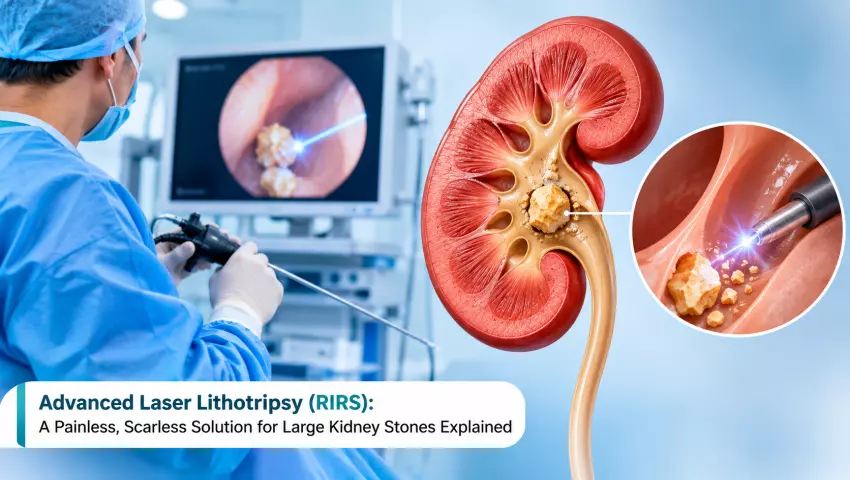
Advanced laser lithotripsy is a minimally invasive approach used to break kidney stones into smaller fragments using specialised laser technology. RIRS stands for Retrograde Intrarenal Surgery. It is an endoscopic procedure in which a thin, flexible instrument called a ureteroscope is passed through the urethra and bladder into the ureter and kidney.
Once the stone is located, the urologist passes a fine laser fibre through the scope. Laser energy is used to break the stone into tiny fragments or dust-like particles. Depending on the stone’s size, location and characteristics, the fragments may be removed using a small basket or allowed to pass naturally through urine.
How Does RIRS Differ from Traditional Kidney Stone Surgery?
Traditional open kidney stone surgery requires a larger surgical incision. RIRS, on the other hand, uses the natural urinary passage to reach the kidney.
The main differences include:
- No external surgical incision.
- No visible surgical scar on the skin.
- Direct visualisation of kidney stones.
- Laser-based stone fragmentation.
- Generally less tissue trauma than open surgery.
- Potentially shorter recovery compared with traditional open procedures.
RIRS is a minimally invasive surgical procedure, not a completely non-invasive treatment. Patients still require anaesthesia and appropriate post-operative monitoring.
How Does Laser Lithotripsy Work During RIRS?
Laser lithotripsy uses concentrated laser energy to fragment kidney stones into smaller pieces. A commonly used technology in endourology is Holmium laser lithotripsy. The laser fibre is passed through the ureteroscope and positioned near the stone. The surgeon carefully delivers laser energy to break the stone into smaller pieces.
Step-by-Step RIRS Procedure:
1. Pre-operative Evaluation:
Before surgery, the urologist evaluates the patient’s medical history, symptoms and diagnostic reports.
Common investigations may include:
- Ultrasound of the kidneys and urinary tract.
- Non-contrast CT scan when required.
- Urine routine and culture.
- Blood investigations.
- Kidney function tests.
These tests help determine the size, number, location and density of kidney stones.
2. Anaesthesia:
RIRS is generally performed under general anaesthesia. The patient is asleep during the procedure and does not experience surgical pain.
3. Flexible Ureteroscope Insertion:
The urologist gently inserts a thin, flexible ureteroscope through the urethra, bladder and ureter to reach the kidney. No external cut is required.
4. Laser Stone Fragmentation:
After identifying the stone, the surgeon introduces a fine laser fibre through the ureteroscope. Laser energy breaks the stone into smaller fragments or fine particles.
5. Stone Fragment Removal:
Depending on the clinical situation, the surgeon may remove fragments using a specialised retrieval basket or allow smaller particles to pass naturally through urine.
6. DJ Stent Placement:
In selected cases, a temporary Double J (DJ) stent may be placed inside the ureter to maintain urine drainage and support healing. The timing of stent removal is decided by the treating urologist.
Is RIRS Suitable for Large Kidney Stones?
This is one of the most common questions patients ask when considering laser kidney stone treatment.
The suitability of RIRS depends on several factors, including:
- Stone size.
- Number of stones.
- Stone location.
- Stone hardness and density.
- Kidney anatomy.
- Patient’s overall health.
- Previous kidney stone procedures.
RIRS can be useful for selected medium-sized, difficult-to-access or complex kidney stones. However, it is not automatically the best option for every large kidney stone. For kidney stones larger than 2 cm, Percutaneous Nephrolithotomy (PCNL) is generally recommended as the first-line surgical treatment under current European Association of Urology guidelines.
In selected patients, RIRS may still be considered when PCNL is unsuitable or when the urologist believes a staged approach is appropriate.
Why Might Large Kidney Stones Require More Than One Procedure?
Larger stones contain more mineral material that needs to be fragmented and cleared. When RIRS is selected for a large or complex stone, the surgeon may need to perform the treatment in multiple sessions.
Possible reasons include:
- Large stone volume.
- Difficult stone location.
- Limited visibility during the procedure.
- Need to minimise pressure and operating time.
- Patient safety considerations.
A staged procedure may improve treatment safety, but it can also mean additional anaesthesia, recovery time and medical expenses. Therefore, the treatment plan should always be based on the patient’s diagnostic reports and clinical condition.
RIRS vs PCNL: Which Kidney Stone Treatment Is Better?
Both RIRS and PCNL are established minimally invasive kidney stone treatment procedures. However, they use different approaches.
RIRS (Retrograde Intrarenal Surgery):
RIRS accesses the kidney through the natural urinary passage.
Key features:
- No external skin incision.
- Uses a flexible ureteroscope.
- Uses laser technology to fragment stones.
- Commonly considered for selected small and medium-sized kidney stones.
- May require staged treatment for larger stones.
PCNL (Percutaneous Nephrolithotomy):
PCNL accesses the kidney through a small incision in the patient’s back.
Key features:
- A small surgical opening is created.
- A nephroscope is introduced directly into the kidney.
- Stones are fragmented and removed through the access tract.
- Generally preferred for large kidney stones, especially those exceeding 2 cm.
RIRS vs PCNL Comparison:
Feature
RIRS
PCNL
Which treatment should you choose?
There is no single treatment suitable for every patient. A urologist evaluates the CT scan, stone size, location, density, kidney function and other medical conditions before recommending RIRS or PCNL. For patients with larger kidney stones, you can also explore PCNL Surgery in Pune to understand this treatment option.
7 Important Benefits of RIRS Laser Kidney Stone Treatment:
RIRS offers several advantages for appropriately selected patients.
- No External Surgical Cuts: The procedure is performed through the natural urinary passage, eliminating the need for an external incision in the back or abdomen.
- No Visible Skin Scars: Because RIRS does not require an external surgical cut, it generally leaves no visible skin scar.
- Precise Stone Treatment: The flexible ureteroscope allows the surgeon to visualise stones inside different areas of the kidney.
- Laser-Based Fragmentation: Laser energy helps break stones into smaller fragments, making removal or natural passage easier.
- Less Tissue Trauma: Compared with conventional open surgery, RIRS generally involves less tissue disruption.
- Faster Return to Routine Activities: Many patients can resume normal activities relatively quickly, depending on the complexity of the procedure and their recovery.
- Treatment of Difficult-to-Reach Stones: The flexible ureteroscope can access several parts of the kidney, including areas that may be difficult to reach using other approaches.
However, these benefits do not mean RIRS is risk-free or completely painless.
Is RIRS Surgery Painless?
RIRS is generally performed under general anaesthesia, so patients do not experience pain during the operation. However, some discomfort may occur after surgery.
Possible post-operative symptoms include:
- Mild burning during urination.
- Blood in the urine.
- Frequent urination.
- Temporary lower abdominal discomfort.
- Flank discomfort due to a DJ stent.
These symptoms are usually manageable with prescribed medicines and medical guidance. Patients should follow their urologist’s instructions regarding pain management, hydration, medicines and follow-up appointments.
Why Choose Leela Superspeciality Hospital for Kidney Stone Treatment in Pune?
Choosing the right urology specialist and hospital is an important step in kidney stone management. Leela Superspeciality Hospital, located in Wakad, Pimpri-Chinchwad, provides specialised urology and andrology care for patients from Pune and PCMC. The hospital’s urology services include kidney stone management, RIRS surgery, PCNL and other minimally invasive urological procedures.
Dr. Akhil S. Mane, Consultant Urologist, Andrologist and Sexologist, provides evaluation and treatment for various urological conditions, including kidney stones. Patients can consult the urology team to understand their diagnosis, available treatment options and the most appropriate surgical approach. Whether RIRS or PCNL is suitable depends on individual clinical evaluation rather than stone size alone.
Frequently Asked Questions About Advanced Laser Lithotripsy and RIRS:
RIRS is generally performed under anaesthesia, so patients do not feel pain during surgery. Temporary discomfort, urinary burning or stent-related symptoms may occur after the procedure.
No. RIRS is performed through the natural urinary passage and does not require an external skin incision or stitches.
Recovery depends on stone complexity, the patient’s health and whether a DJ stent is inserted. Many patients return to routine activities within a few days, subject to their surgeon’s advice.
No. A DJ stent is not mandatory in every case. The urologist decides whether it is required based on the procedure and patient’s condition.
Yes, RIRS can be used to treat multiple stones in selected patients. The number, size and location of the stones determine whether one or multiple sessions may be needed.
Yes. RIRS treats existing stones but does not eliminate the underlying factors responsible for stone formation. Adequate hydration, dietary guidance, stone analysis and follow-up can help reduce the risk of recurrence.
Patients looking for kidney stone treatment in Pune and PCMC can consult the urology team at Leela Superspeciality Hospital, Wakad, for an evaluation and personalised treatment advice.
Conclusion:
Advanced laser lithotripsy through Retrograde Intrarenal Surgery (RIRS) has become an important option in modern kidney stone treatment. Its incision-free approach, flexible endoscopic access and laser-based stone fragmentation offer significant benefits for appropriately selected patients.
However, RIRS is not automatically the best treatment for every large kidney stone. PCNL is generally preferred for stones larger than 2 cm, while RIRS may be appropriate in selected cases.
The right treatment depends on accurate diagnosis, stone characteristics and the patient’s overall health. If you are experiencing kidney stone symptoms or have been advised to undergo surgery, consult an experienced urologist to understand your options.
Book a Urology Consultation at Leela Superspeciality Hospital, Wakad, Pune:
Consult Dr. Akhil S. Mane for professional evaluation of kidney stones and guidance on suitable treatment options, including RIRS and PCNL.
- Call: +91 76898 92020
- Website: https://www.leelasuperspecialityhospital.com/
- Address: Fourth Floor, Westwood Estates Commercial Complex, Kaspate Wasti, Wakad, Pimpri-Chinchwad, Pune, Maharashtra 411057.
