
- 23/09/2026
- Dr. Akhil Mane
- 0 Comments
- Urology
DJ Stent for Kidney Stones: Procedure, Benefits, and Recovery
If your doctor has recently recommended a DJ stent after your kidney stone surgery, you are not alone — and you probably have a lot of questions. What is a DJ stent? Why do you need one? Will it hurt? How long does it stay in?
DJ stent full form is Double-J stent — a thin, flexible plastic tube placed inside the ureter to maintain urine flow from the kidney to the bladder. It is one of the most commonly used tools in kidney stone treatment in Pune and across India. Dr. Akhil S. Mane, Best Urologist in Wakad PCMC, with over 12 years of experience and more than 10,000 patients treated, places DJ stents routinely at Leela Superspeciality Hospital Wakad as part of advanced kidney stone surgery care.
This blog explains everything you need to know — in simple, clear language.
What Is a DJ Stent?
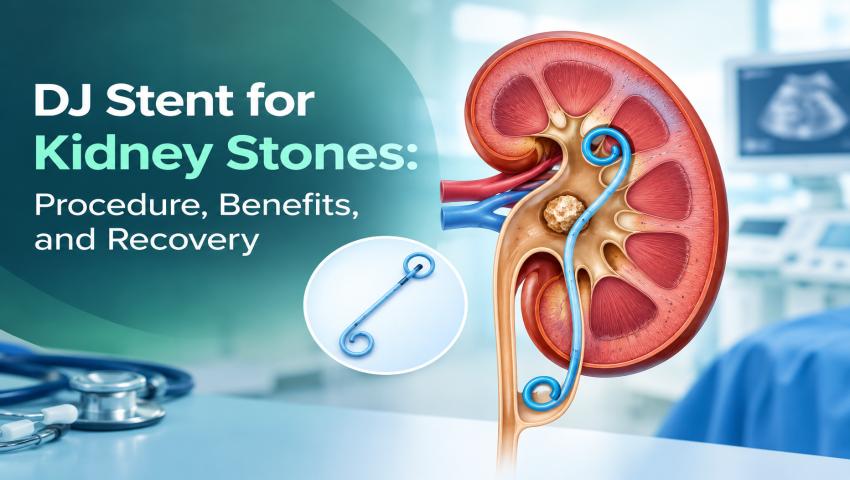
A DJ stent — also called a Double J stent for kidney stones or a ureteric stent — is a soft, flexible plastic tube approximately 24 to 30 cm long. It gets its name from the J-shaped curls at both ends.
- One curl sits inside the kidney
- The other curl sits inside the bladder
- The tube runs through the ureter — the channel connecting the kidney and bladder
These J-shaped ends keep the stent securely in place and prevent it from moving. The stent allows urine to flow freely from the kidney to the bladder — even when the ureter is swollen, narrowed, or recovering from surgery.
Why Is a DJ Stent Placed for Kidney Stones?
DJ stent uses in kidney stone care are wide-ranging. A DJ stent for kidney stones is placed when:
- The ureter is swollen or inflamed after kidney stone surgery — blocking normal urine flow
- Large stone fragments have been broken during URSL surgery in Pune or PCNL surgery in Pune — and the ureter needs time to heal.
- The stone caused a ureter blockage, and the kidney was under pressure for some time.
- There is a risk of steinstrasse — a condition where multiple stone fragments line up in the ureter after laser treatment.
- The ureter has a stricture or narrowing that needs to be kept open during healing.
URSL with DJ stenting and PCNL with DJ stenting are now standard surgical combinations — significantly reducing the risk of post-operative complications and kidney damage.
How Is a DJ Stent Inserted? — Step-by-Step Procedure?
Step 1
Anaesthesia:
Step 2
Cystoscope Insertion:
Step 3
Guidewire Placement:
Step 4
Stent Placement:
Step 5
Guidewire Removal:
Step 6
Confirmation:
Benefits of DJ Stent After Kidney Stone Surgery:
A stent for kidney stone surgery offers several critical advantages during recovery:
- Maintains urine drainage — Prevents urine from backing up into the kidney after surgery
- Reduces kidney pressure — Protects kidney function during the healing period
- Prevents ureteral collapse — Keeps the ureter open so it heals in the correct shape
- Facilitates stone fragment passage — Allows residual fragments to pass naturally into the bladder
- Prevents complications — Significantly reduces the risk of ureter blockage, infection, and kidney damage post-surgery
- Supports healing — Acts as a scaffold for the ureter to heal properly after URSL or PCNL surgery
How Long Does a DJ Stent Stay In?
The duration of ureteral stent placement depends on the reason it was inserted, the size of the stone, and how quickly the ureter heals.
- After URSL for small to medium stones — 1 to 2 weeks
- After PCNL for large or complex stones — 2 to 4 weeks
- After complex reconstruction or stricture — 4 to 12 weeks
Dr. Akhil S. Mane advises patients never to remove or ignore the stent beyond the recommended time. Leaving a DJ stent in longer than prescribed increases the risk of encrustation, infection, and stone formation on the stent itself.
DJ Stent Side Effects — What to Expect?
Kidney stent side effects are very common — almost all patients experience some degree of discomfort. Knowing what to expect helps patients prepare.
Common DJ stent side effects include:
- Frequent urination — the bladder curl causes irritation
- Burning or discomfort during urination
- Blood in urine — mild haematuria is normal, especially after physical activity
- Lower abdominal discomfort or bladder spasms
- Mild flank or back pain — particularly after urinating
- Feeling of incomplete bladder emptying
Less common DJ stent discomfort includes:
- Mild fever — report to your doctor if temperature exceeds 38.5°C
- Visible blood clots in urine
- Stent migration — rare but requires prompt medical attention
Double J stent complications are generally manageable with prescribed medications — including antispasmodics, pain relievers, and antibiotics. DJ stent discomfort management is a key part of the post-operative care plan at Leela Superspeciality Hospital, Wakad.
Life With a DJ Stent — Tips to Manage Daily Activities:
Living with a DJ stent requires some adjustments — but most patients manage their routine well with the right guidance.
- Hydration — Drink at least 2.5 to 3 litres of water daily to flush the urinary tract
- Light activity — Walking and gentle movement are encouraged — but avoid strenuous exercise, heavy lifting, and contact sports
- Rest when needed — Fatigue and mild discomfort are normal in the first few days.
- Avoid long car or bike rides — Vibration can worsen discomfort.
- Take prescribed medications — Antispasmodics significantly reduce bladder cramping.
- Avoid sexual activity — until the stent is removed and your doctor gives clearance.
- Monitor urine colour — Light pink is acceptable, but bright red or clots need immediate attention.
How Is a DJ Stent Removed?
DJ stent removal procedure is quick, simple, and performed in the outpatient clinic — no hospital admission required in most cases.
Method 1 — Cystoscopy (Most Common):
DJ stent removal cystoscopy involves passing a small flexible cystoscope through the urethra into the bladder. The stent is grasped with small forceps and gently pulled out. The procedure takes 5 to 10 minutes under local anaesthesia and is very well tolerated by most patients.
Method 2 — String Removal:
In some cases, a thin thread — called the removal string — is left attached to the stent and exits through the urethra. Kidney stent removal with string is an office procedure where the doctor gently pulls the string to remove the stent — no cystoscope needed. This is typically used for short-term stents of 1 to 2 weeks.
Recovery After DJ Stent Removal:
Kidney stent removal recovery is generally quick. Most patients feel significantly better within 24 to 48 hours of stent removal.
- Mild burning during urination for 1 to 2 days — completely normal
- Increased urinary frequency for the first day — settles quickly
- Light pink urine for 24 hours — expected
- Resume normal diet, activity, and work within 1 to 2 days
- Attend a follow-up appointment for post-removal kidney stone surgery recovery assessment
- Continue hydration — at least 2 to 3 litres of water daily for one week
DJ stent side effects and recovery improve rapidly once the stent is out — most patients are pleasantly surprised at how quickly they feel normal again.
DJ Stent vs No Stent After Kidney Stone Surgery:
When to Call Your Doctor Immediately?
Contact your urologist immediately if you experience:
- High fever above 38.5°C with chills — may indicate kidney infection or sepsis
- Severe pain not relieved by prescribed medications
- Complete inability to urinate
- Heavy bleeding or large blood clots in urine
- Sudden worsening of flank pain
- Stent string coming out unintentionally
Book an Appointment with Dr. Akhil S. Mane:
If you have been advised a DJ stent for kidney stones or are experiencing discomfort with an existing stent — prompt expert care makes all the difference.
For DJ stent insertion, monitoring, and removal in Pune, consult Dr. Akhil S. Mane — Best Urologist in Wakad PCMC — at Leela Superspeciality Hospital Wakad. Transparent guidance, advanced care, and complete support throughout your kidney stone treatment in Pune.
- Phone: +91 7689892020
- Address: Fourth Floor, 403-404, Kaspate Wasti, Wakad, Pune — 411057
- Hours: Open 24 Hours
FAQs About DJ Stent for Kidney Stones in Pune:
Duration depends on the procedure performed. After URSL surgery, stents are typically removed in 1 to 2 weeks. After PCNL surgery for larger stones, 2 to 4 weeks is standard. Always follow your urologist’s specific recommendation — leaving a stent in beyond the advised period significantly increases the risk of infection and encrustation.
Most patients experience mild to moderate discomfort with a DJ stent — including frequent urination, burning, blood in urine, and bladder spasms. These kidney stent side effects are normal and managed with prescribed medications. Severe pain, high fever, or inability to urinate requires immediate medical attention at Leela Superspeciality Hospital Wakad.
DJ stent removal procedure involves a quick cystoscopy — a small flexible camera passed through the urethra to grasp and remove the stent. It takes 5 to 10 minutes under local anaesthesia and is generally well tolerated. If a string was attached, kidney stent removal with string is even simpler — a gentle pull in the clinic removes it without any instruments.
Light daily activities like walking, office work, and gentle household tasks are generally fine. However, avoid strenuous exercise, heavy lifting, long vehicle rides, and sexual activity until the stent is removed. Stay well hydrated and take all prescribed medications for DJ stent discomfort management throughout the stent period.
Dr. Akhil S. Mane is the most trusted and experienced urologist for DJ stent insertion, monitoring, and removal in Wakad, Pune — with 12+ years of specialised experience in kidney stone treatment in Pune and more than 10,000 patients treated. Consult Dr. Akhil S. Mane at Leela Superspeciality Hospital Wakad for expert, confidential, and comprehensive kidney stone care.
