
- 06/06/2026
- Dr. Akhil Mane
- 0 Comments
- Urology
URSL vs PCNL: Which Kidney Stone Surgery is Right for You?
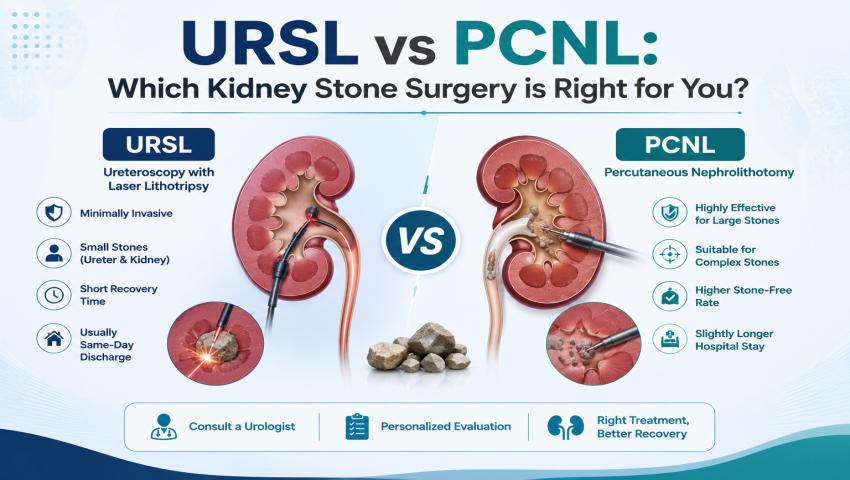
When your doctor tells you that your kidney stone needs surgery, the next question that comes to mind is — which surgery? Two of the most commonly performed kidney stone surgeries in India today are URSL (Ureteroscopic Lithotripsy) and PCNL (Percutaneous Nephrolithotomy). Both are effective, both are minimally invasive, but they are designed for very different situations.
Choosing the right surgery depends on the size, location, and number of stones — and most importantly, on the expertise of your surgeon. Dr. Akhil S. Mane, a leading Urologist in Wakad, PCMC with over 12 years of experience and more than 10,000 patients treated, performs both URSL and PCNL surgeries at Leela Superspeciality Hospital, Wakad — one of Pune’s most trusted urology centres. This blog will help you understand the key differences between these two procedures so you can make a confident, informed decision.
What Is URSL (Ureteroscopic Lithotripsy)?
URSL stands for Ureteroscopic Lithotripsy. It is a minimally invasive kidney stone surgery where a thin, flexible telescope called a ureteroscope is passed through the urethra and bladder into the ureter or kidney — without any cuts or incisions on the body.
Once the stone is located, a laser (usually Holmium laser) is used to break the stone into tiny dust-like particles that pass out naturally through urine.
Key facts about URSL:
- No external cuts or incisions
- Performed under general or spinal anaesthesia
- Suitable for small to medium-sized stones
- Day care or 1-day hospital stay in most cases
- Also called Laser Lithotripsy or Ureteroscopy with Lithotripsy
What Is PCNL (Percutaneous Nephrolithotomy)?
PCNL stands for Percutaneous Nephrolithotomy. It is a minimally invasive kidney stone surgery where the surgeon makes a small keyhole incision (about 1 cm) in the patient’s back to directly access the kidney and remove large or complex stones.
A nephroscope is inserted through this small opening, and the stone is broken using ultrasonic or laser energy and removed directly from the kidney.
Key facts about PCNL:
- Requires a small keyhole incision in the back
- Performed under general anaesthesia
- Best for large, complex, or multiple kidney stones
- Hospital stay of 2 to 3 days typically
- Available in three variants — Standard PCNL, Mini PCNL, and Ultra-Mini PCNL
How Does URSL Work? — Step by Step
- Anaesthesia — The patient is given general or spinal anaesthesia
- Ureteroscope insertion — A thin flexible scope is gently passed through the urethra into the bladder and up into the ureter or kidney.
- Stone identification — The surgeon locates the stone using the scope’s camera
- Laser fragmentation — A Holmium laser fibre is passed through the scope to break the stone into fine dust or small fragments
- Passage of fragments — Dust particles pass naturally through urine; larger fragments may be removed using a small basket
- Stenting (if needed) — A temporary ureteral stent (DJ stent) may be placed to help urine drain properly during healing.
- Recovery — Most patients go home the same day or the next morning
How Does PCNL Work? — Step by Step
- Anaesthesia — General anaesthesia is administered
- Patient positioning — Patient is positioned face down (prone position) for direct kidney access
- Imaging guidance — Fluoroscopy or ultrasound is used to precisely locate the kidney and stone
- Keyhole incision — A small 1 cm incision is made in the back to create a direct tract into the kidney
- Nephroscope insertion — A nephroscope is passed through the tract directly into the kidney
- Stone fragmentation — The stone is broken using ultrasonic or laser energy into smaller pieces
- Stone removal — Fragments are directly suctioned or extracted from the kidney
- Nephrostomy tube — A small drainage tube may be placed post-surgery, temporarily
- Recovery — Hospital stay of 2 to 3 days with full recovery in 1 to 2 weeks
URSL vs PCNL — Key Differences at a Glance:
When Is URSL Recommended?
Dr. Akhil S. Mane recommends URSL for kidney stone surgery in the following situations:
- Stones located in the ureter (upper, middle, or lower)
- Kidney stones smaller than 15 mm in size
- Stones that have not passed on their own despite medication
- Patients experiencing severe pain, urinary blockage, or recurrent infections due to stones
- Patients who want a scar-free, quick-recovery procedure
- Patients who are not suitable for more invasive procedures due to health conditions
- Stones causing hydronephrosis (swelling of the kidney due to urine blockage)
URSL is particularly preferred for working professionals and patients who need to return to normal activities quickly, as recovery is typically within 3 to 5 days.
When Is PCNL Recommended?
PCNL is the preferred Kidney Stone Surgery for the following situations:
- Stones larger than 15 to 20 mm in the kidney
- Staghorn calculi — large stones that fill the entire kidney collecting system
- Multiple stones in the kidney
- Stones that have failed treatment with URSL or shockwave lithotripsy (SWL)
- Hard stones that cannot be broken by a laser through a ureteroscope
- Anatomical abnormalities of the kidney where URSL cannot access the stone
- Stones causing repeated urinary tract infections or kidney damage
As a skilled Robotic Uro Surgeon and kidney stone specialist at Leela Superspeciality Hospital, Wakad, Dr. Akhil S. Mane carefully evaluates each patient’s imaging reports, stone burden, and overall health before recommending PCNL — ensuring the best possible outcomes with minimal risk.
Stone Size Guide — Which Surgery for Which Stone?
Conclusion:
Both URSL and PCNL are safe, effective, and minimally invasive kidney stone surgeries — each designed for a specific type of stone. URSL is ideal for smaller stones in the ureter with no incisions and a faster recovery. PCNL is the gold standard for large, complex, or multiple kidney stones where direct access to the kidney is needed.
The right choice is never one-size-fits-all. It depends on your stone size, location, kidney anatomy, and overall health — and that decision is best made with an experienced specialist. If you are in Pune and looking for expert kidney stone care, consult Dr. Akhil S. Mane at Leela Superspeciality Hospital, Wakad, for a thorough evaluation and a personalised treatment plan that is right for you.
