
- 14/07/2026
- Dr. Akhil Mane
- 0 Comments
- Urology
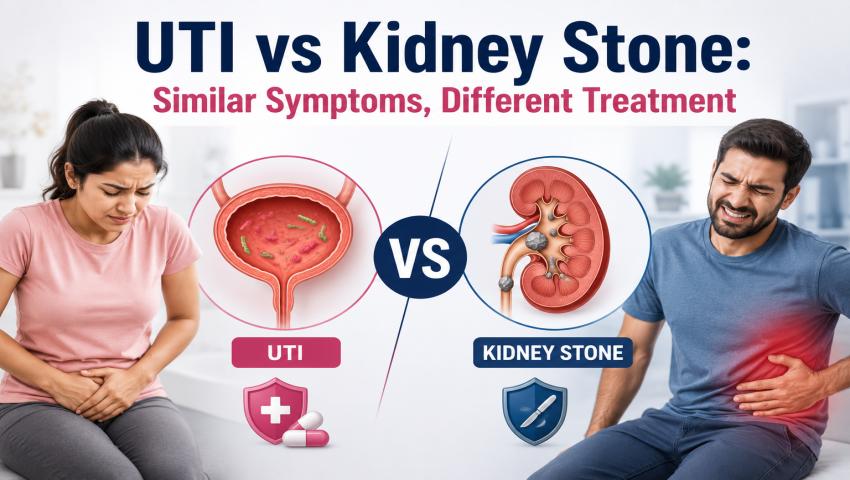
UTI vs Kidney Stone: Similar Symptoms, Different Treatment
Burning when you urinate. Pain in your lower abdomen. A constant urge to go to the bathroom. These symptoms sound like a classic urinary tract infection — but what if they are actually a kidney stone?
UTIs and kidney stones are two of the most common urinary conditions seen by urologists in India. They share several overlapping symptoms, which makes them notoriously easy to confuse. But here is the critical point — they are completely different conditions that require completely different treatments. Giving antibiotics for a kidney stone will not help. And ignoring a UTI will not make it pass on its own.
Dr. Akhil S. Mane, Best Urologist in Pune with over 12 years of experience and more than 10,000 patients treated at Leela Superspeciality Hospital Wakad, regularly sees patients who have been mismanaging one condition thinking it is the other. This blog will help you tell them apart — clearly and confidently.
What Is a UTI?
A urinary tract infection (UTI) is a bacterial infection that affects any part of the urinary system — the urethra, bladder, ureters, or kidneys. The most common cause is E. coli bacteria entering the urinary tract.
Key facts about UTI:
- Extremely common — approximately 60 percent of women and 12 percent of men experience at least one UTI in their lifetime
- Caused by bacteria — not minerals or structural issues
- Treatable with antibiotics — most cases clear within 3 to 7 days
- Can spread to the kidneys if left untreated — causing pyelonephritis, a serious kidney infection
- Women are more prone due to a shorter urethra — making it easier for bacteria to reach the bladder
What Is a Kidney Stone?
A kidney stone is a hard deposit of minerals and salts that forms inside the kidney. Medically known as renal calculi or nephrolithiasis, kidney stones develop when urine becomes too concentrated with substances like calcium, oxalate, or uric acid.
Key facts about kidney stones:
- Not an infection — a structural condition, not caused by bacteria
- Stone in urine forms when mineral crystals clump together over time
- Small kidney stones may pass on their own without treatment
- Larger stones can block the ureter — the tube connecting the kidney to the bladder
- Lower ureter stones are particularly painful as they cause intense renal colic
- Urine color with kidney stones may be pink, red, or brown due to blood
UTI vs Kidney Stone — Key Differences at a Glance:
Pain — The Most Important Difference:
Pain is the clearest way to distinguish between these two conditions — and the most important difference to understand.
UTI pain:
- Dull, constant ache concentrated in the lower abdomen or pelvic area
- Uncomfortable but rarely stops you from functioning
- Does not radiate to the back or sides
- Worsens with urination
Kidney stone pain:
- One of the most intense pains a person can experience
- Sharp, severe, and wave-like — called renal colic
- Starts in the flank (back, just below the ribs) and radiates toward the lower abdomen or groin as the stone moves
- Kidney stones pain area changes as the stone travels through the ureter
- Comes in waves — intensifies and eases as the stone shifts position
- Ureteral stone signs and symptoms include sudden, severe flank pain that can cause nausea, vomiting, and sweating
The bottom line — if your pain is severe, wave-like, and radiating from your back to your groin, think kidney stone. If the pain is a dull ache in the lower abdomen with burning urination, think UTI.
Urinary Symptoms — How They Overlap and How They Differ?
Both conditions cause urinary symptoms — which is exactly why they are confused. Here is how to read the subtle differences:
Frequent urination:
- With a UTI — the urge is constant and each time only small amounts of urine pass
- With a kidney stone — the urge is linked to the stone moving through the ureter, not a bacterial trigger
Burning during urination:
- Strong with a UTI — dysuria is a hallmark symptom
- Can occur with kidney stones when the stone reaches the lower ureter — but is usually less prominent than kidney stones symptoms pain
Blood in urine (Hematuria):
- Common in both conditions
- With UTI — urine may appear cloudy or foul-smelling alongside the blood
- Kidney stones urine color tends to be pink, red, or brown without the cloudiness or smell
Other Symptoms — Fever, Nausea, and Blood in Urine
Fever:
- Common with UTIs — particularly when the infection has spread to the kidneys (pyelonephritis)
- With kidney stones — fever only occurs if there is also an infection alongside the stone
Nausea and Vomiting:
- Strongly associated with kidney stones — the severe pain triggers a nausea response
- Less common with uncomplicated UTIs
Chills and sweating:
- More commonly seen with kidney stones — particularly when the pain is at its peak
- Can also indicate a serious UTI that has spread to the kidneys
Can You Have a UTI and Kidney Stone at the Same Time?
Yes — and this is more common than most people realise. Research shows that 18 to 36 percent of patients experience both conditions simultaneously.
Here is why they are connected:
- Does kidney stones cause UTI? Yes — when a stone blocks urine flow, it creates conditions where bacteria thrive and multiply — increasing infection risk
- Struvite kidney stones — a specific type — are directly caused by certain bacteria that produce enzymes changing urine chemistry
- People with recurrent kidney stones have a significantly higher risk of developing recurrent UTIs
- When both occur together, the combination is more serious — requiring treatment of both the infection and the stone simultaneously
If you have both conditions together, consult Dr. Akhil S. Mane at Leela Superspeciality Hospital Wakad immediately — this combination requires careful, coordinated treatment to avoid kidney damage or sepsis.
How Is a UTI Diagnosed?
- Urinalysis — A urine test checks for white blood cells, bacteria, and nitrites — key markers of infection.
- Urine Culture — Identifies the specific bacteria causing the infection and determines which antibiotic will work best.
- Physical Examination — The doctor checks for tenderness in the lower abdomen and flanks.
- Urine Culture and Sensitivity — Ensures the right antibiotic is prescribed — particularly important for recurrent UTIs.
How Is a Kidney Stone Diagnosed?
How to know if you have kidney stones — these are the standard diagnostic tools:
- CT Scan (KUB) — The gold standard for kidney stone diagnosis. Identifies stone size, location, and number with high accuracy.
- Ultrasound — Safe, radiation-free option — particularly useful for pregnant women or children. Detects most kidney and upper ureter stones.
- X-Ray (KUB) — Identifies calcium-containing stones in the urinary tract.
- Urinalysis — Checks for blood in urine and signs of associated infection.
- Blood Tests — Assess kidney function and mineral levels — calcium, uric acid, and creatinine.
Treatment for UTI — Antibiotics and More:
- Antibiotics — First-line treatment. Most UTIs respond within 3 to 7 days. Always complete the full course.
- Increased fluid intake — Flushes bacteria from the urinary tract
- Pain relief — Phenazopyridine helps reduce burning discomfort during urination
- Avoid caffeine, alcohol, and spicy foods — These irritate the bladder during recovery
- For recurrent UTIs — Long-term low-dose antibiotics or post-intercourse antibiotics may be prescribed
Treatment for Kidney Stone — From Fluids to Surgery:
Treatment depends on stone size, location, and severity:
Small stones (less than 5 mm):
- Drink 2.5 to 3 litres of water daily to help flush the stone
- Pain medication — NSAIDs or prescribed analgesics
- Alpha-blockers — relax the ureter muscles to help the stone pass faster
- Most small kidney stones pass naturally within 2 to 4 weeks
Medium to large stones:
- URSL Surgery in Pune — Laser lithotripsy through a ureteroscope — ideal for ureteral stones
- PCNL Surgery in Pune — Keyhole surgery for large kidney stones above 2 cm
- Shockwave Lithotripsy (SWL) — Sound waves break the stone into smaller pieces that pass naturally
Infected stone with UTI:
- Requires urgent antibiotics alongside stone treatment
- Emergency drainage if the stone is causing a blocked, infected kidney
UTI vs Kidney Stone — Treatment Comparison:
How to Prevent UTI and Kidney Stones?
To prevent UTIs:
- Drink at least 2 to 3 litres of water daily
- Urinate after sexual activity
- Wipe front to back — particularly important for women
- Avoid holding urine for long periods
- Wear breathable, cotton underwear
To prevent kidney stones:
- Stay well hydrated — the single most effective prevention
- Reduce salt and animal protein in diet
- Limit oxalate-rich foods — spinach, nuts, chocolate — if prone to calcium oxalate stones
- Avoid crash diets — rapid weight loss increases uric acid in urine
- Get regular urine tests if you have a history of stones
When to See a Urologist in Pune?
See a urologist immediately if you experience:
- Severe, uncontrolled flank or abdominal pain
- High fever above 38.5°C with urinary symptoms
- Inability to urinate or very reduced urine output
- Persistent blood in urine
- Recurrent UTIs — more than two in six months
- UTI that is not responding to antibiotics after 48 hours
- Known kidney stone that is not passing after 4 weeks
Why Choose Dr. Akhil S. Mane for Urinary Health in Pune?
Patients across Wakad, Hinjewadi, Baner, Pimpri-Chinchwad, and PCMC choose Dr. Akhil S. Mane as their trusted Urologist in Hinjewadi, PCMC, Pune — and here is why:
- 12+ Years of Specialised Urology Experience — Deep expertise in kidney stone treatment in Pune, UTI management, and complex urological conditions
- Advanced Surgical Skills — Expert in PCNL Surgery in Pune and URSL Surgery in Pune for all stone sizes and locations
- 10,000+ Patients Treated — Proven clinical track record at Leela Superspeciality Hospital Wakad
- Accurate Diagnosis First — Every patient receives a thorough clinical evaluation before any treatment is recommended
- Complete Urological Care — From UTI management to robotic urology — all under one roof
Book an Appointment with Dr. Akhil S. Mane:
Do not let confusion about your symptoms delay the right treatment. Whether you are dealing with a UTI, a kidney stone, or both — Dr. Akhil S. Mane at Leela Superspeciality Hospital Wakad provides fast, accurate diagnosis and effective, personalised treatment.
- Phone: +91 7689892020
- Address: Fourth Floor, 403-404, Kaspate Wasti, Wakad, Pune — 411057
- Hours: Open 24 Hours
FAQ's About UTI vs Kidney Stone:
The key difference is pain type and location. UTI pain is a dull ache in the lower abdomen with constant burning urination. Kidney stone pain is severe, sharp, and wave-like — starting in the back or flank and radiating toward the groin. A urine test can help diagnose a UTI, while imaging like a CT scan or ultrasound diagnoses kidney stones. When unsure, always consult a urologist — never self-diagnose.
Yes — when a kidney stone reaches the lower ureter, it can cause burning during urination that feels very similar to a UTI. This happens because the stone irritates the ureter lining as it moves toward the bladder. However, kidney stone burning is usually accompanied by severe flank pain and urine color change — pink or red — which is less common in a straightforward UTI. Blood tests and imaging can confirm the diagnosis.
Yes — research shows 18 to 36 percent of patients experience both simultaneously. Does kidney stones cause UTI? Yes — a stone blocking urine flow creates conditions where bacteria multiply rapidly, causing infection. Struvite kidney stones are specifically linked to bacterial infections. If you have both, prompt treatment from a Best Urologist in Wakad PCMC is essential — treating only one condition while ignoring the other can lead to serious complications, including kidney damage and sepsis.
Dr. Akhil S. Mane is the most trusted urologist for kidney stone treatment in Pune and UTI management in Wakad PCMC — with 12+ years of specialised experience, 10,000+ patients treated, and advanced expertise in URSL and PCNL surgery. He practises at Leela Superspeciality Hospital, Wakad — easily accessible from Hinjewadi, Baner, Pimpri-Chinchwad, and all major PCMC areas. Call +91 76898 92020 to book your consultation today.
